
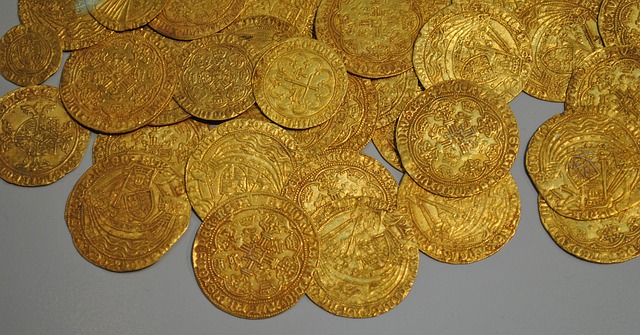
The price of gold has reached historic levels, surpassing $3,500 per ounce in 2025, driven by economic uncertainty, inflation, and strong demand from central banks. Considered a safe haven against crises and currency depreciation, the precious metal has established itself as a strategic asset in times of volatility. However, its history of sharp declines raises the risk of a bubble. While some analysts project it will continue rising, others anticipate severe corrections. Gold remains a symbol of confidence, but also of vulnerability in the global economy.
A Historic Gold Surge
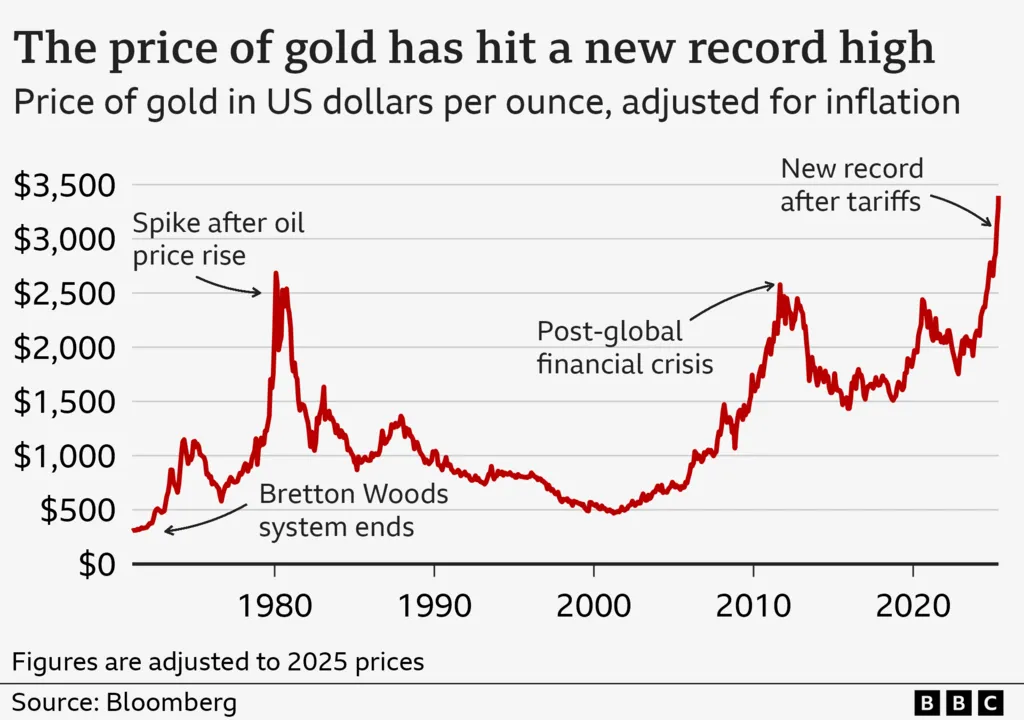
Since 1970, when an ounce of gold was priced at just $296, the metal has gone through cycles of boom and bust. Its price reached $2,684 in 1980, boosted by the oil crisis, before plunging below $500 in the 2000s. In 2011, after the global financial crisis, it soared again to $2,577.
In March 2025, gold set a new all-time record by exceeding $3,124 per ounce, partly due to economic uncertainty stemming from the trade policies of U.S. President Donald Trump. A month later, in April, it broke the $3,500 barrier (£2,630), reaching an absolute peak even adjusted for inflation.
The price has surged more than 40% in the last year, fueled by recession fears, rising geopolitical tensions, and growing demand from central banks.
Between Fever and Caution
The current phenomenon is not without risks. History shows that every gold rush has been followed by sharp corrections. In 1980, for example, the price plummeted 65% in just over a year. In 2011, after hitting its peak, it fell 35% in just two years.
Today, analysts are divided: while firms such as Goldman Sachs project that gold could reach $4,000 per ounce in 2026, others warn of a possible bubble. Jon Mills, an expert at Morningstar, estimates that if mining production increases and central bank demand decreases, the price could drop to $1,820 in the coming years.
Nevertheless, in a global scenario marked by geopolitical tensions, persistent inflation, and financial market volatility, most strategists agree that gold will remain a key asset in investment portfolios.
The Rise of Gold: Causes and Consequences of a Booming Market
Over the past decade, the economic value of gold has experienced a meteoric rise, breaking historical records and becoming one of the most coveted assets in times of uncertainty. What factors explain this phenomenon and what are its implications for key sectors such as jewelry and technology?
Gold as a Safe Haven
Gold’s appeal lies in its relative scarcity and its historic status as a safe haven asset. Unlike stocks, it pays no dividends; unlike bonds, it generates no predictable cash flows. However, it is perceived as insurance against inflation and as a tangible asset beyond the control of central banks.
“Governments can print money, but not gold,” summarizes Russ Mould, Investment Director at AJ Bell. In an environment where monetary policy typically responds to crises with rate cuts, liquidity injections, and quantitative easing programs, gold solidifies its role as a store of value.
In recent years, gold-backed exchange-traded funds (ETFs) and, above all, massive purchases by central banks—with acquisitions exceeding 1,000 tons annually since 2022—have accelerated the price surge. Countries like China, Turkey, India, and Poland lead this trend, motivated by diversification and growing distrust towards the dollar-dominated financial system.
The global economic instability of the past ten years has driven higher demand for safe haven assets. These assets, considered to have intrinsic value, remain stable even during financial crises or periods of high inflation.
Historically, gold represents the preservation of wealth better than any other asset. Though it does not always offer extraordinary returns, it is a fundamental tool for diversifying portfolios and protecting against extreme events.
Other safe havens include sovereign bonds from fiscally solid countries, such as German Bunds, Europe’s benchmark for public debt performance. Also tangible assets like jewelry, works of art, luxury watches, or real estate, whose value tends to appreciate over time.
In figures, the shift is clear: in 2013, the price hovered around $1,200 per ounce; in 2023 it surpassed $1,900 and reached peaks near $2,000. On January 31, 2025, the price stood at €2,812.50 per ounce, more than doubling its value in just a decade.
Eternal Refuge or a Bubble in the Making?
Gold has proven to be a haven in times of crisis, but its volatility also exposes investors to the risk of sharp losses. At the current crossroads—where U.S. economic policy, central bank strategies, and international conflicts converge—the future of the precious metal remains uncertain.
The only clear thing is that gold, far from being a “useless” asset, as Warren Buffett once called it, continues to be the thermometer of distrust in the global economy.
Technology and Manufacturing: Gold as a Strategic Input
Gold does not only shine in jewelry. Its properties—high electrical conductivity, corrosion resistance, and malleability—make it indispensable for cutting-edge sectors.
Electronics and telecommunications: Present in microprocessors, connectors, and components for smartphones, computers, and automobiles, gold ensures efficiency and durability. The digital expansion and growing demand for devices have boosted its consumption to unprecedented levels.
Aerospace and medical biotechnology: Thanks to its chemical stability and thermal resistance, gold is used in precision equipment and advanced medical treatments. Rising prices have a direct impact on production costs and, consequently, on access to technology and healthcare services.
The sustained increase in its price generates inflationary pressures for companies that depend on this metal, forcing them to innovate in efficient resource use without sacrificing quality or performance.
Impact on the Jewelry Sector
The jewelry market is one of the most affected by gold’s rising costs:
• Higher retail prices: Heavy, elaborate pieces have given way to lighter and more affordable designs, adapted to consumers’ purchasing power.
• Expansion of the secondhand market: More people are selling old jewelry or buying pre-owned pieces, driving the recycling and reuse of precious metals.
• Lighter designs: The challenge is to reduce gold use without compromising durability or aesthetics, essential factors in perceived value. An Ev
An Even More Golden Future?
All signs point to the upward trend continuing over the next ten years, supported by
• Geopolitical and economic instability, maintaining demand for safe haven assets.
• Technological expansion, with sectors like artificial intelligence, renewable energy, and space exploration demanding more gold.
• Transformation of the jewelry market, where the metal could become even more exclusive or, in some cases, be replaced by alternative materials.
• Financial investment, with gold confirming its status as an essential component of portfolios in volatile times.
In this scenario, it is possible that the ounce will surpass $3,000 by 2035, redefining business models in industries dependent on this metal.
In conclusion
Del escaparate de las joyerías a los laboratorios de biotecnología, el oro sigue marcando el pulso de la economía global. Su encarecimiento no solo transforma hábitos de consumo y estrategias empresariales, sino que también refleja la búsqueda constante de seguridad en un mundo cada vez más incierto.
If you are interested in learning more about Investment Banking services and corporate finance consulting, we can assist you. Contact us at info@avacum.com and we will answer all your questions related to venture capital. If you are an entrepreneur, you might also be interested in learning about other forms and sources of private financing for startups.
References
Interesting pages. https://www.investing.com/ https://www.nyse.com/index | https://hbr.org/ | SEC | Harvard Business Review | Bloomberg.com | https://www.business.qld.gov.au/running-business/risk/identify-manage
Finanzas corporativas en línea: https://avacum.com | Corporate finance advisory https://pdv-a.com Para una mayor información: Info@pdv-a.com
- Informes de consultoras como McKinsey, Bain & Company, y PwC sobre tendencias globales en M&A.
- Artículos académicos y estudios de casos publicados en revistas como Harvard Business Reviewy Journal of Finance.
- Artículos académicos y estudios: PDVa,
- Banco de inversioón en línea: Avacum
- Curso de finanzas en línea: Vosverum.
- Base de datos e información: Investing, Bloomberg, OCDE, International Monetary Fund,
Interesting pages. https://www.investing.com/ https://www.nyse.com/index | https://hbr.org/ | SEC | Harvard Business Review | https://www.business.qld.gov.au/running-business/risk/identify-manage
Finanzas corporativas en línea: https://avacum.com | Corporate finance advisory https://pdv-a.com Para una mayor información: Info@pdv-a.com
Sobre cursos de finanzas y contenidos: info@akademiun.com | https://akademiun.com
Si quieres conocer más de nuestros cursos, visita la página: https://vosverum.com/ | Si te interesara conocer más acerca los servicios de Banca de Inversión y consultoría en finanzas corporativas, podemos ayudarte. Contacta con nosotros en info@avacum.com y te resolveremos todas las dudas relacionadas con el capital de riesgo. Si eres un emprendedor, también te puede interesar conocer otras formas y fuentes de financiación privada de Startups.
Curso en Línea Disponibles en Vosverum.com
Artículos de Finanzas personales
https://vosverum.com/2023/adquirir-tu-primer-automovil/
https://vosverum.com/2023/proceso-de-adquisicion-de-un-inmueble/
https://vosverum.com/2023/gestion-finanzas-personales-estabilidad/
https://vosverum.com/2021/finanzas-personales-objetivos/
https://vosverum.com/2021/finanzas-personales-punto-de-partida/
https://www.khanacademy.org/college-careers-more/personal-finance


 English
  Spanish

Leave A Comment